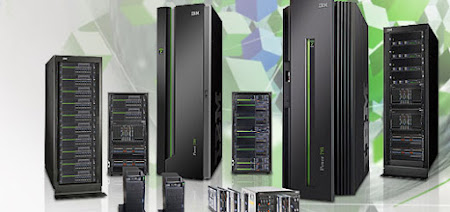
IBM System i advertisement (No Stress)
IBM Server iSeries
It's IBM
IBM Power Systems
Tuesday, February 2, 2010


History, CPU in AS/400, iSeries, i5 & Models
History
The IBM System i, then known as the AS/400, was the continuation of the System/38 database machine architecture (announced by IBM in October 1978 and delivered in August 1979). The AS/400 removed capability-based addressing.[3] The AS/400 added source compatibility with the System/36 combining the two primary computers manufactured by the IBM Rochester plant. The System/36 was IBM's most successful mini-computer but the architecture had reached its limit. The first AS/400 systems (known by the development code names Silverlake and Olympic) were delivered in 1988, and the product line has been refreshed continually since then. The programmers who worked on OS/400, the operating system of the AS/400, did not have a UNIX background. Dr Frank Soltis, the chief architect, says that this is the main difference between this and any other operating system.The AS/400 was one of the first general-purpose computer systems to attain a C2 security rating from the NSA (Gould UTX/C2, a UNIX-based system was branded in 1986[4]), and in 1995 was extended to employ a 64-bit processor and operating system.
In 2000 IBM renamed the AS/400 to iSeries, as part of its e-Server branding initiative. The product line was further extended in 2004 with the introduction of the i5 servers, the first to use the IBM POWER5 processor. The architecture of the system allows for future implementation of 128-bit processors when they become available. Existing applications can use the new hardware without modification.
Hardware
The AS/400 was originally based on a custom IBM CISC CPU which used a CPU architecture known as Internal Micro Programmed Interface (IMPI) and an instruction set similar to the IBM 370. It was later migrated to a POWER-based RISC CPU family eventually known as RS64.
CPU in AS/400, iSeries, i5
The System i5 uses IBM POWER CPUs. These CPUs are developed and manufactured by IBM. The POWER 4/5/5+ chips contain two cores. There are Multi-Chip Modules (MCM) available. They have 2 CPUs (4 cores) or 4 CPUs (8 cores) in one MCM.
Models : AS/400, iSeries, i5

Monday, February 1, 2010
IBM System i
The IBM System/38 was introduced in July 1980 as a minicomputer for general business and departmental use. It was replaced by the AS/400 midrange computer in 1987 and later re branded as the eServer iSeries in 2000. It was renamed in 2006 as the IBM System i until April 2008 when it was replaced by the IBM Power Systems line. It uses an object-based operating system called IBM iOS. The operating system has undergone name changes in accordance with the re-branding of the IBM server line. Initially, it was called OS/400 (following the name schema that gave birth to OS/2 and OS/390). Later on became known as i5/OS in line with the introduction of the eServer i5 servers featuring POWER5 processors. Finally, it was called just IBM i coinciding with the 6.1 release. Features include a DBMS (DB2/400), a menu-driven interface, multi-user support, dumb terminal support (IBM 5250), printers, as well as security, communications and web-based applications, which could be executed either inside the (optional) IBM WebSphere application server or in PHP/MySQL[1] using a native port of the Apache web server. While in Unix-like systems “everything is a file”, on the System i everything is an object, with built-in persistence and garbage collection. It also offers Unix-like file directories using the Integrated File System.[2] Java compatibility is implemented through a native port of the Java virtual machine.
Features
The IBM System i platform extended the System/38 architecture of an object-based system with an integrated DB2 relational database. Equally important were the virtual machine and single-level storage concepts which established the platform as an advanced business computer.
Software
The IBM System i includes an extensive library-based operating system, i5/OS, and is also capable of supporting multiple instances of AIX, Linux, Lotus Domino, Microsoft Windows 2000 and Windows Server 2003. While i5/OS, AIX, Linux and Lotus Domino are supported on the POWER processors, Windows is supported with either single-processor internal blade servers (IXS) or externally-linked multiple-processor servers (IXA and iSCSI). iSCSI also provides support for attachment of IBM Bladecenters. Windows, Linux, and VMWare ESX(VI3) are supported on iSCSI attached servers.
LPAR (Logical Partitioning), a feature introduced from IBM's mainframe computers, facilitates running multiple operating systems simultaneously on one IBM System i unit. A system configured with LPAR can run various operating systems on separate partitions while ensuring that one OS cannot run over the memory or resources of another. Each LPAR is given a portion of system resources (memory, hard disk space, and CPU time) via a system of weights that determines where unused resources are allocated at any given time. The operating systems supported (and commonly used) under the LPAR scheme are i5/OS, AIX, and Linux.
Other features include an integrated DB2 database management system, a menu-driven interface, multi-user support, non-programmable terminals (IBM 5250) and printers, security, communications, client-server and web-based applications. Much of the software necessary to run the IBM System i is included and integrated into the base operating system.
The IBM System i also supports common client-server-based technologies such as ODBC and JDBC for accessing its database from client software such as Java, Microsoft .NET languages and others.The IBM System i also provides an environment for AIX applications to run natively on i5/OS without the need for an AIX LPAR. AIX programs are binary compatible with OS/400 when using OS/400's PASE (Portable Applications System Environment). PASE is essentially "an operating system within an operating system", supporting the most recent stable version of AIX. Binaries need to be re-compiled on the AIX system, with 16-byte (quadword) pointer alignment enabled. Once the program is compiled with this option, it can be executed under the PASE Korn Shell.
The IBM System i platform extended the System/38 architecture of an object-based system with an integrated DB2 relational database. Equally important were the virtual machine and single-level storage concepts which established the platform as an advanced business computer.
Software
The IBM System i includes an extensive library-based operating system, i5/OS, and is also capable of supporting multiple instances of AIX, Linux, Lotus Domino, Microsoft Windows 2000 and Windows Server 2003. While i5/OS, AIX, Linux and Lotus Domino are supported on the POWER processors, Windows is supported with either single-processor internal blade servers (IXS) or externally-linked multiple-processor servers (IXA and iSCSI). iSCSI also provides support for attachment of IBM Bladecenters. Windows, Linux, and VMWare ESX(VI3) are supported on iSCSI attached servers.
LPAR (Logical Partitioning), a feature introduced from IBM's mainframe computers, facilitates running multiple operating systems simultaneously on one IBM System i unit. A system configured with LPAR can run various operating systems on separate partitions while ensuring that one OS cannot run over the memory or resources of another. Each LPAR is given a portion of system resources (memory, hard disk space, and CPU time) via a system of weights that determines where unused resources are allocated at any given time. The operating systems supported (and commonly used) under the LPAR scheme are i5/OS, AIX, and Linux.
Other features include an integrated DB2 database management system, a menu-driven interface, multi-user support, non-programmable terminals (IBM 5250) and printers, security, communications, client-server and web-based applications. Much of the software necessary to run the IBM System i is included and integrated into the base operating system.
The IBM System i also supports common client-server-based technologies such as ODBC and JDBC for accessing its database from client software such as Java, Microsoft .NET languages and others.The IBM System i also provides an environment for AIX applications to run natively on i5/OS without the need for an AIX LPAR. AIX programs are binary compatible with OS/400 when using OS/400's PASE (Portable Applications System Environment). PASE is essentially "an operating system within an operating system", supporting the most recent stable version of AIX. Binaries need to be re-compiled on the AIX system, with 16-byte (quadword) pointer alignment enabled. Once the program is compiled with this option, it can be executed under the PASE Korn Shell.
Subscribe to:
Posts (Atom)

 Posts
Posts

